

 Contact us
 Visit CPRE.org
 Donate
Data Centres
Data Centres have been in the news a lot with some groups calling for a moratorium on any more building until the government has a clear plan of the needs and locations.
Data Centres – what and where?
Data centres handle all the digital data which has become a part of everyday life. We accept that our files and photos are stored in ‘the cloud’, but the cloud is now beginning to make itself apparent in the form of data centres. Artificial Intelligence (AI) is contributing to the increased need. The physical consequences of this technology revolution and our dependence on digital applications is now becoming a more tangible issue.
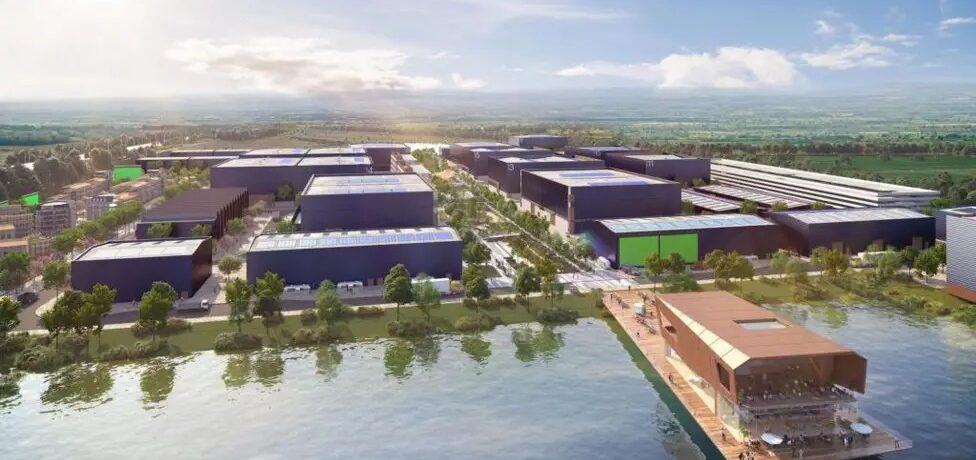
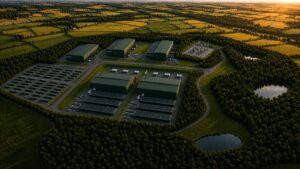
Data centres may look like the usual warehouses or offices that pop up across the country but have different sustainability issues. Seen as essential to support our AI and digital driven economy, they are considered as Critical National Infrastructure making planning permission easier to obtain. But the lack of local consultation isn’t going unnoticed. Many protest groups are now emerging to fight back. A particularly prominent one in Devon has seen residents protesting over plans to build a data centre and battery storage unit in the middle of the rural county. Covering 850 acres of agricultural land it would be the largest centre in Europe. See below for a link to the CPRE Devon Campaign.
Not a new story
There are estimated to already be around 400 data centres across the country and many more proposed. Many are in the home counties supporting the data hungry businesses in London. Slough has so far emerged as the data centre capital. With around 40 data centres, it is has the largest cluster in Europe. They service big tech companies such as Google and Microsoft.
What are the environmental concerns?
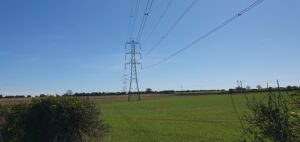
Although AI promises to make life more efficient, data centres are far from helping with carbon net-zero target. For the data centres waiting to join the national grid the total energy use would be in the region of 73GW. This is well above the country’s 45GW peak electricity demand. In 2023 it was estimated that data centres used a fifth of the country’s energy demand
And it isn’t just electricity; the data centres need water to cool the facilities. With concerns about water security and supply, particularly in the south of the country the challenge to service our digital needs is growing.
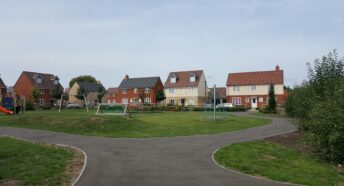
When sited in the countryside the land data centres take, most commonly, productive agricultural land.
Although the actual processing of data should be silent, the power used generates heat. Data centres need fans to prevent the system overheating. Some data centres also produce noise from substation transformers supplying the electricity. These processes create constant low whirring and thrum sounds from the buildings.
There are also some claims that the heat generated by data centres can increase the temperature in the local vicinity.
What is happening in Bedfordshire
Central Bedfordshire currently has three data centre proposals in the planning pipeline. The most advanced is the Linmere Island Site in Houghton Regis, within the parish of Chalton.
Linmere Island Site, Houghton Regis
The site lies to the north-east of Houghton Regis, in a light industrial and commercial area close to the M1 and the A5 Dunstable Northern Bypass. It is bordered by a public park to the west, a supermarket to the south, and a Lidl distribution centre to the east. The planning application was approved by the Central Bedfordshire Council Development Management Committee in May 2026.
The approved development includes:
- two data centre buildings
- approximately 51,300 square metres (around 12 acres)
- a substation compound
- two medium-voltage switch rooms
Stewartby on land known as Quest Pit
Quest Pit submitted a request in April 2026 to bring both a “data centre campus” and an already proposed on-site gas generating station into a single application.
Due to the size of the data centre development it will be considered as Nationally Significant Infrastructure Project. The planning permission will be considered at central government level rather than locally. Stakeholders such as the Central Bedfordshire Council and the national energy supplier will be consulted but there will be no local planning application.
The Quest Park data centre campus will:
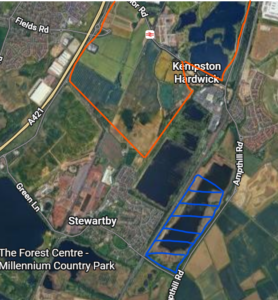
- occupy approximately 143 acres at Ampthill Road, Stewartby, south-west of Bedford. The site is a former Hanson Brick clay pit that ceased operations in 2008
- have four data centre buildings
- provide a digital training facility. This would provide science, technology, engineering and mathematics students with facilities for education and research, preparing them for careers in the technology sector
- expect to have the first data halls operating in 2030 with phased expansion to follow
This site already has permission granted for a film studio, indicating that the brownfield site is suitable for development.
In the image below, the blue area indicates the proposed location of the data centre campus, not far from the Universal UK theme park marked in orange.
Toddington Park
Toddington Park is being developed by IM Properties and Moto as a proposed strategic employment and energy development at Junction 12 of the M1.
The planning application includes:
- expanded parking for HGVs and electric HGVs
- up to two buildings that could house data centres; with air-cooling technology intended to reduce reliance on water supplies for cooling
The developer is also proposing a nearby country park as biodiversity offset.
Can you do anything?
Like many other aspects of our lives, we should consider the consequences of consumption. It is easy to buy and use products and services to make our lives easy, but we should take a moment to consider the environmental effects of our everyday consumption. AI has sneaked into many aspects of our lives often unnoticed as busy lives increasingly use digital applications. Data centres are one of the consequences.
Data centres are storing files, photos and other digital outputs, so you can try and reduce your digital footprint:
- Clear your cloud – delete old files, photos and unused emails which are stored in remote servers (the cloud)
- Consider AI use – resource heavy AI tools increase data centre energy demands, so try to minimise AI use
- Get rid of unnecessary data – unsubscribe from mailing lists and delete unused online accounts which sit in the background storing your data.
What are CPRE Bedfordshire doing?
In line with our usual approach, we will review planning applications in relation to the Local Plan expectations and other policy principles. For Nationally Strategic Infrastructure projects we will consider the local perspective and liaise with local government and MPs to represent any local concerns.
We are part of a national CPRE working group considering the best approach to these types of development. The necessity for data centres must be acknowledged but we are looking for a sustainable way forward and aim the produce a ‘data centres done well’ policy approach in the near future.
CPRE Devon – campaigning against a monster
CPRE Devon are campaigning against the huge proposal in North Devon. You can find out more here and by watching this video below. To register to object visit this page.